If you read our complete guide to soundproofing a basement ceiling, you noticed two products kept coming up as the serious upgrades: mass loaded vinyl (MLV) and Green Glue. It is natural to ask which one you should buy.
Here is the honest answer up front: they are not really competitors. MLV adds mass. Green Glue damps vibration. Those are two different jobs, and the best basement ceilings often use both. This post will explain what each one does, compare them fairly on cost, thickness, noise type, and installation, and then help you pick the right one — or both — for your specific situation.
What Is Mass Loaded Vinyl (MLV)?
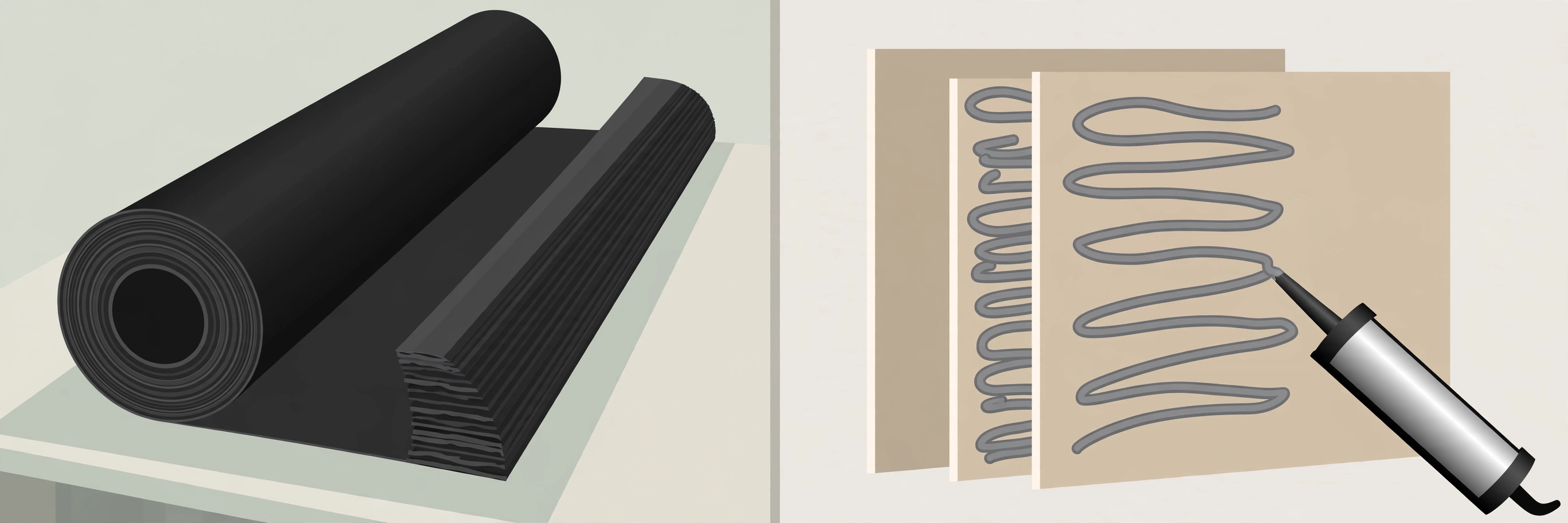
Mass loaded vinyl is exactly what the name says: a vinyl sheet loaded with heavy mineral fillers (usually barium sulfate or calcium carbonate) until it weighs about 1 pound per square foot while staying roughly 1/8 inch thick.
MLV works on the oldest rule in soundproofing: mass blocks sound. A heavier barrier is harder for sound waves to push around, so less sound gets through. MLV’s trick is delivering a lot of mass in very little thickness, which matters in basements where every inch of ceiling height counts.
How it is used on a basement ceiling:
- Stapled or screwed to the underside of the subfloor (or to the first layer of drywall), seams overlapped by 2 inches and taped with acoustic tape.
- Always covered by a layer of drywall. MLV is not a finished surface, and in most jurisdictions a vinyl sheet should not be left exposed on a ceiling for fire-safety reasons — check your local building and fire codes before planning any ceiling assembly.
- Works best as one layer in a larger assembly: subfloor, insulation between joists, MLV, then drywall.
What MLV is good at: adding mass cheaply and thinly, which helps most with airborne noise — voices, TV, music. Its weakness: it does not decouple anything or damp vibration, so on its own it underperforms against impact noise like footsteps.
What Is Green Glue?
Green Glue (formally Green Glue Noiseproofing Compound) is a viscoelastic damping compound that comes in caulk-style tubes. You apply it between two layers of drywall, and it converts sound vibration into tiny amounts of heat instead of letting the drywall ring like a drum.
The key thing to understand: Green Glue is not a mass product and not an adhesive in the structural sense. The screws still hold the drywall; the compound just sits between the layers and stays permanently flexible. Its entire job is damping — killing the resonance of the drywall panels themselves.
How it is used on a basement ceiling:
- Applied in a random bead pattern on the back of the second drywall layer — two tubes per 4×8 sheet (the dosage matters; skimping measurably reduces performance).
- The second layer is hung within about 15 minutes, screwed through to the framing or resilient channel.
- It needs roughly 30 days to fully cure. You hear improvement immediately, and it keeps getting better over the first month.
What Green Glue is good at: damping panel resonance, which makes it especially effective against impact noise — footsteps, thumping — when combined with a decoupled assembly. Its limitation: it does nothing by itself. Green Glue with only one layer of drywall is just expensive caulk — it requires the two-layer sandwich to work at all.
MLV vs Green Glue: Head-to-Head
| Mass Loaded Vinyl (MLV) | Green Glue | |
|---|---|---|
| What it does | Adds mass (blocks sound) | Damps vibration (kills resonance) |
| Form | 1 lb/sq ft flexible sheet, ~1/8″ thick | Viscoelastic compound in tubes, applied between two drywall layers |
| Typical DIY cost | ~$1.50–2.50 per sq ft (material only) | ~$1.25–1.75 per sq ft for the compound alone; ~$8–15 per sq ft as part of a full double-drywall assembly |
| Thickness added | ~1/8″ plus the drywall that covers it | One extra layer of 5/8″ drywall (~5/8″) plus a thin compound layer |
| Best noise type | Airborne (voices, TV, music) | Impact (footsteps, thumping), especially with decoupling |
| Works alone? | Helps alone, but underperforms without the rest of an assembly | No — requires two layers of drywall to function |
| Installation difficulty | Moderate — cutting and hanging heavy rolls overhead is awkward; a 4×25 ft roll can weigh 100 lbs, so bring a helper | Moderate — if you can hang drywall, you can do this; adds ~10 minutes per sheet |
| Cure/wait time | None — works the moment it is installed | ~30 days to full cure |
A note on those cost figures: they are rough 2026 DIY material estimates, and prices vary by supplier and region. The Green Glue number looks dramatically higher because it is really the cost of the assembly Green Glue requires — a second layer of 5/8″ drywall, extra screws, and the labor of hanging it. The fair comparison is assembly to assembly.
When MLV Wins
Choose MLV as your primary upgrade when:
- Your ceiling is low. At 7 feet or less, every inch matters. MLV adds serious mass in 1/8 inch. A full Green Glue double-drywall assembly eats roughly 2 inches once you count both layers. In a basement where you are already ducking under a duct, that difference is real.
- Your problem is mostly voices, TV, and music. Airborne noise responds to mass, and MLV is the thinnest mass you can buy. Sealed gaps + insulation + MLV + one layer of drywall is a legitimate budget assembly for airborne noise, running roughly $3–6 per square foot DIY.
- You want the simplest possible upgrade. MLV goes up with staples or screws and acoustic tape on the seams. No second layer of drywall to hang, no mudding and taping an extra layer, no waiting a month for cure.
MLV’s honest weakness: screwed directly to joists with a single drywall layer, it does little for footsteps. Impact vibration travels through the joists and the hard-mounted drywall regardless of added mass.
When Green Glue Wins
Choose Green Glue as your primary upgrade when:
- Footsteps and impact noise are the main problem. This is Green Glue’s home turf. Damping kills the drywall resonance that turns every footstep into a drumbeat. Paired with resilient channel (decoupling) and mineral wool (absorption), a double-drywall Green Glue assembly is the closest thing to a “done right” residential basement ceiling.
- You are already planning double drywall. If the plan includes two layers of 5/8″ drywall anyway, adding Green Glue between them is a modest extra cost for a large performance gain. The compound is the cheapest part of that assembly — the drywall and labor dwarf it.
- You want the maximum quiet and have the budget and headroom for it. The full stack — insulation, resilient channel, double drywall with Green Glue — runs $8–15 per square foot DIY, but nothing else in the residential world performs like it short of a fully floated ceiling.
Green Glue’s honest weakness: cost and thickness. You are buying and hanging twice the drywall, which doubles the finishing work. And none of it matters if you skip the fundamentals — unsealed gaps around can lights will leak sound past the fanciest assembly you can build.
The Case for Using Both
Here is the part most “versus” articles skip: MLV and Green Glue are compatible, and high-performance assemblies use them together. They do not interfere with each other because they do completely different things.
A maximum-performance basement ceiling stack can look like this, from top to bottom:
- Subfloor above
- Mineral wool insulation between joists
- MLV stapled to the underside of the subfloor (seams overlapped 2″, taped)
- Resilient channel
- First layer of 5/8″ drywall
- Green Glue
- Second layer of 5/8″ drywall
- Acoustic sealant at all edges
The MLV adds mass early in the stack. The resilient channel decouples the drywall from the joists. The Green Glue damps the double-drywall sandwich. Each layer attacks a different weakness, which is why the combination outperforms any single product.
The honest caveat: diminishing returns are real. Going from nothing to a good assembly is a dramatic change; going from good to great by adding MLV on top of Green Glue is subtler — and you pay full price for it. For most homeowners, the money is better spent getting the fundamentals right (sealing, insulation, decoupling, one good damping layer) than stacking every product in the catalog.
Also note the practical costs of the full stack: it is heavy, it eats 2+ inches of headroom, and it is a serious weekend (or two) of overhead work. Plan accordingly.
Decision Guide: Which Should You Buy?
“My basement ceiling is 7 feet and I mostly hear the TV and conversations.”
MLV. You need mass without losing headroom, and your noise is airborne. Seal gaps, add mineral wool, hang MLV, cover with one layer of drywall.
“I hear every footstep and my kids sound like a herd of elephants.”
Green Glue — as part of double drywall on resilient channel. Impact noise needs decoupling plus damping. MLV alone will not solve this.
“I want the quietest basement possible and cost is secondary.”
Both. Build the full stack above: insulation, MLV, resilient channel, double drywall with Green Glue. Seal everything.
“I am on a tight budget and want the best value per dollar.”
Neither, yet. Seal the gaps ($30–60 in acoustic sealant) and add mineral wool between the joists ($1–3/sq ft) first — that is the best dollars-to-results ratio in soundproofing. Then, if you add one product, MLV gives you the most improvement per dollar because it does not require a second layer of drywall.
“I am renting / I need something reversible.”
Neither is truly reversible once screwed up, but MLV under a drop-ceiling grid or simply laid above acoustic tiles is the least permanent option. Green Glue’s double-drywall assembly is a permanent modification — do not install it in a space you do not own without permission.
One more consideration before you buy either: check your local building and fire codes. Finished-basement ceiling assemblies may have fire-rating requirements, and some jurisdictions restrict exposed vinyl products. A quick call to your local building department beats a failed inspection.
Installation Notes: MLV
- Measure and cut with a sharp utility knife and straightedge; the material is dense and dulls blades fast, so keep spares.
- Overlap all seams by 2 inches and seal them with acoustic tape — an unsealed seam is a sound leak.
- Fasten with staples or screws with large washers so the fasteners do not tear through the sheet.
- It is heavy: a 4×25-foot roll can weigh 100 lbs. Unroll and cut it on the floor, carry pieces up, and work with a helper. Do not try to hold a full roll overhead by yourself.
- MLV must be covered by drywall — never leave it as an exposed ceiling surface.
Installation Notes: Green Glue
- Two tubes per 4×8 sheet. Apply in a random bead pattern, not a neat grid — random works better.
- Hang the second drywall layer within about 15 minutes of applying the compound.
- The compound is not structural; screws still do all the holding. Do not reduce your screw schedule.
- Expect about 30 days for full cure. You will notice a difference immediately, with continued improvement over the first month.
- Cleanup is with water while wet. Once cured, it is permanent — protect floors and finished surfaces before you start.
- Green Glue between two layers of drywall on resilient channel is the high-performance configuration. Green Glue between two layers screwed directly to joists still helps, but you leave performance on the table without decoupling.
FAQ
Can I use MLV and Green Glue together?
Yes — they are designed to do different jobs and do not interfere with each other. MLV adds mass; Green Glue damps vibration between two drywall layers. A common high-performance stack is MLV on the subfloor, then resilient channel, then double drywall with Green Glue. Just know that each additional layer has diminishing returns, so get the fundamentals (sealing, insulation, decoupling) right first.
Which is better for footsteps from upstairs?
Green Glue, as part of a double-drywall assembly on resilient channel. Footsteps are impact noise — vibration traveling through the structure — and damping plus decoupling is the correct treatment. MLV adds mass but does not break the vibration path, so on its own it underperforms against impact noise.
Which is better for voices and TV noise?
Either works, because airborne noise responds to mass and both approaches add it. MLV is usually the simpler and thinner option: one layer of MLV plus drywall handles voices and TV well without the cost and labor of hanging a second drywall layer.
Can I install MLV or Green Glue myself?
Yes to both, with caveats. MLV is straightforward DIY — cutting, stapling, taping — but the rolls are heavy and overhead work is tiring, so get a helper. Green Glue is easy to apply, but it requires hanging a full second layer of drywall, including taping, mudding, and sanding. If you have never finished drywall, budget time to learn or hire out the finishing.
Does Green Glue work without a second layer of drywall?
No. Green Glue only functions as a damping layer sandwiched between two rigid panels. Applied to a single layer of drywall with nothing over it, it does essentially nothing. The second layer of drywall is not optional — it is half the product.
Is MLV worth it compared to just adding more drywall?
Sometimes. A second layer of drywall is cheaper per square foot than MLV and adds real mass. MLV’s advantage is thickness: it delivers about the same mass as a layer of 5/8 inch drywall in 1/8 inch. If you have headroom to spare, double drywall (with or without Green Glue) is usually the better value. If your ceiling is already low, MLV earns its price.
How long does Green Glue take to start working?
You will hear an improvement as soon as the assembly is complete, but Green Glue takes about 30 days to fully cure, with performance improving gradually over that period. MLV, by contrast, works at full performance the moment it is installed.
Do I need resilient channel if I use MLV or Green Glue?
You do not need it, but decoupling is the single biggest upgrade for impact noise, and both products perform better in a decoupled assembly. If footsteps are your problem and the ceiling is open anyway, resilient channel plus either product will outperform either product alone on hard-mounted drywall.