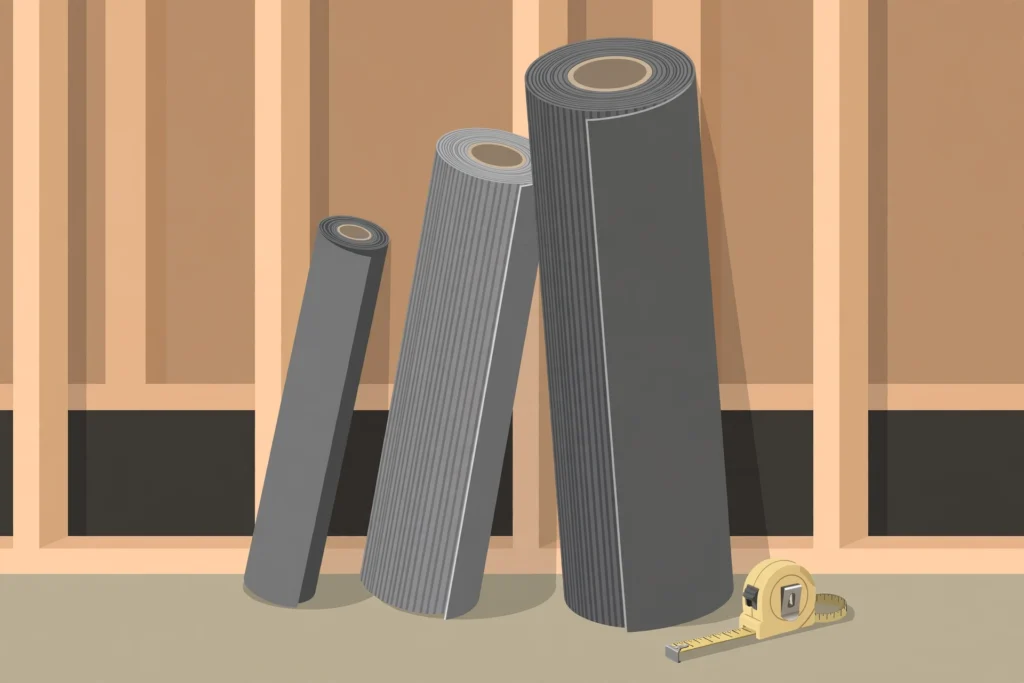
If you have already sealed the obvious gaps in your basement walls and the noise is still coming through, mass loaded vinyl (MLV) is usually the next thing people reach for. It is one of the few soundproofing materials that adds serious mass to a wall without stealing several inches of room, which is exactly what you want in a basement where every inch of ceiling height and floor space already feels precious.
But MLV is not a commodity. Options differ in weight per square foot, thickness, backing, and price, and the wrong pick can mean a wall that is under-damped, a nightmare to hang, or money spent where Green Glue or a second layer of drywall would have done more. This guide compares five common MLV options by the specs that actually matter for basement walls, names clear winners in three categories, and is honest about where MLV falls short.
How MLV Works (and Why Basements Love It)
MLV is a dense, flexible sheet material made from barium sulfate, calcium carbonate, or similar heavy mineral fillers suspended in vinyl. It is limp, meaning it does not ring or resonate like a sheet of metal. When sound waves hit a limp, heavy barrier, most of the energy is reflected and a portion is converted to heat as the dense material flexes.
The governing principle is the mass law: roughly speaking, doubling the mass of a wall assembly raises its sound blocking by about 5 decibels, and a 5-point STC gain is a clearly noticeable improvement. MLV delivers that extra mass in a sheet as thin as 1/16 of an inch, which is why it shows up in basement walls, home theaters, and retrofit projects where framing out a deeper wall is not practical.
Basements add one more reason to like MLV. Concrete and block walls already give you mass, but they also transmit sound efficiently when they are rigid and continuous. A limp mass layer decoupled on the room side of the wall behaves differently from the rigid concrete, and that difference is where the extra blocking comes from.
What to Compare Before You Buy
Every MLV product can be reduced to four numbers and one yes-or-no question:
Weight per square foot. The standard grades are 1/2 lb, 1 lb, and 2 lb per square foot. One-pound MLV is the workhorse. Two-pound MLV doubles the mass and typically adds several more STC points, but it is dramatically harder to hang. Half-pound MLV exists for light-duty jobs but rarely earns its place on a basement wall.
Thickness. One-pound MLV is usually around 1/8 inch thick. Two-pound MLV runs about 1/4 inch. Peel-and-stick versions may measure slightly thicker because of the adhesive layer. Thickness matters most where clearances are tight, around pipes, windows, and door frames.
Price per square foot. This is the great equalizer. A 2-lb roll can cost 60 to 80 percent more per square foot than 1-lb MLV, and you also need more fasteners, stronger adhesive, and often a helper to install it. Always compare on a per-square-foot basis, including seam tape and adhesive if you need them.
Reinforced or plain. Some MLV has a polyester scrim embedded or laminated into the sheet. Reinforced MLV tears far less at staple and nail holes, which matters on basement walls where you are hanging it vertically on studs or furring strips.
The yes-or-no question: adhesive or not? Self-adhesive (peel-and-stick) MLV installs fast on flat concrete or drywall, but it costs more per square foot and the bond can fail on dusty or damp basement concrete. Non-adhesive MLV hung on studs with nails and staples is the more forgiving choice in a basement.
The 5 Options, Compared
Option 1: Standard 1-lb MLV (4′ x 25′ roll) — Best Overall
The plain 1-lb roll is the default for a reason. At roughly 1/8 inch thick and 1 pound per square foot, it hits the sweet spot of mass, manageability, and price. A 4-by-25-foot roll covers 100 square feet and weighs 100 pounds, heavy, but a two-person crew can still handle it.
For a basement wall framed with 2×4 studs, the standard play is to hang 1-lb MLV on the studs, seal every seam with acoustic seam tape or caulk, and cover it with one or two layers of drywall. Because the material is limp, it does not add the stiffness that can work against you in a wall assembly.
Buy it in rolls rather than pre-cut sheets. Rolls minimize seams, and seams are the weak point of every MLV job. If you are covering an entire basement wall, fewer seams means fewer chances for leaks.
Option 2: Budget 1-lb MLV (thinner private-label rolls) — Best Budget
The budget tier is usually 1-lb MLV sold in smaller rolls or thinner gauge from generic suppliers. On paper it is the same weight per square foot, so the mass law still applies. In practice, budget rolls sometimes measure slightly under the nominal thickness and the vinyl can feel stiffer, which makes it marginally less limp and marginally harder to get flat on a wall.
For basement walls, this tradeoff is usually acceptable if you install carefully. Sound blocking comes from mass and airtightness, and a careful installation of budget MLV beats a sloppy installation of premium MLV every time. Where budget rolls genuinely lose is durability: thinner vinyl tears more easily at fastener points, so use more fasteners, wider washers, or furring strips to spread the load, and tape every seam generously.
This is the right pick when you are covering a large area and the math on premium rolls gets painful. Expect to spend some of your savings on extra fasteners and seam tape.
Option 3: 2-lb MLV — Best for Maximum Blocking
Two-pound MLV packs twice the mass into roughly 1/4 inch of thickness. The mass law says that should buy you roughly another 5 STC points over 1-lb MLV in the same assembly, and manufacturer test data generally bears that out. If your goal is the highest blocking you can get without framing out a second wall, this is the product.
The cost is real. A 2-lb roll weighs twice as much per square foot, and hanging a 4-foot-wide sheet vertically on a basement wall becomes a two-person-plus job. Adhesive alone will not hold it reliably on concrete; you need mechanical fasteners, furring strips, or hat channel. It is also the most expensive option per square foot, often running 60 to 80 percent more than 1-lb MLV before you factor in the heavier-duty fasteners and the extra labor.
Choose 2-lb MLV for a dedicated theater room, a practice space, or a wall shared with a genuinely loud neighbor. For a general-purpose finished basement, 1-lb MLV plus a second layer of drywall usually gets you there for less money and much less suffering.
Option 4: Peel-and-Stick (Self-Adhesive) 1-lb MLV — Best for Tight Spaces
Self-adhesive MLV trades some cost for speed. You peel the backing, press it onto a clean flat surface, and you are done, no studs, no staples, no furring strips stealing inches from the room. In a basement where you are wrapping around pipes, boxing in a sump pump, or lining a cramped utility closet, that convenience is genuinely valuable.
The caveats are specific to basements. The adhesive needs a clean, dry, relatively smooth surface. Dusty concrete, painted block with efflorescence, or any dampness will weaken the bond, and a sheet of MLV peeling off the wall at 2 a.m. is the kind of surprise nobody wants. If your basement walls are bare concrete, seal and clean them first, or fasten the MLV mechanically and skip the adhesive premium.
Option 5: Reinforced (Scrim-Backed) MLV — Best for Basement Durability
Reinforced MLV has a polyester scrim laminated into or onto the vinyl. It costs a little more per square foot than plain MLV, and what you get is tear resistance. On basement walls, where you are hanging heavy sheets vertically and fastening into masonry or uneven framing, that tear resistance pays for itself. Fewer tears at fastener points means fewer patches, fewer weak spots, and a longer-lived installation.
The acoustic performance is the same as plain MLV of the same weight; the scrim is about handling, not blocking. Some reinforced products also have a slightly more textured surface that takes adhesive better, which is a small bonus if you are gluing MLV to concrete or drywall.
This is the pick for DIY installers, first-timers, and anyone hanging MLV on masonry anchors or older, uneven basement framing. The premium is small and the forgiveness is large.
Head-to-Head Comparison
| Option | Weight | Thickness (approx.) | Relative price | Best for |
|---|---|---|---|---|
| Standard 1-lb roll | 1 lb/sq ft | 1/8 in | Baseline | Most basement walls |
| Budget 1-lb roll | 1 lb/sq ft | ~1/8 in | Lowest | Large areas on a budget |
| 2-lb MLV | 2 lb/sq ft | 1/4 in | Highest | Maximum blocking |
| Peel-and-stick 1-lb | 1 lb/sq ft | ~1/8 in + adhesive | High | Tight spaces, retrofits |
| Reinforced 1-lb | 1 lb/sq ft | ~1/8 in | Slightly above baseline | DIY and masonry walls |
For the basement walls most people are actually building, [AFFILIATE: standard-1lb-mlv-roll] is the sensible starting point, and if you are hanging it yourself on uneven walls, the reinforced version is worth the small step up in price.
Installation Essentials for Basement Walls
MLV only works if it is installed as a continuous, airtight barrier. Sound behaves like water: it finds the gaps. These are the non-negotiables:
Overlap and seal every seam. Overlap seams by at least 2 inches and seal them with acoustic seam tape or a bead of acoustic caulk. Butt joints that are not sealed are the number one reason MLV underperforms its specs.
Hang it limp, not stretched tight. MLV works because it is limp mass. Stretching it tight across studs couples it to the framing and gives up some of the benefit. Let it hang with a slight drape, and fasten at the top and sides rather than pulling it drum-tight.
Cover it. MLV is a vinyl product and should not be left exposed as a finished surface. Cover it with drywall, which also adds more mass to the assembly. One layer of 5/8-inch drywall over 1-lb MLV is a solid minimum for a finished basement wall.
Mind the edges. The perimeter of the wall, the top plate, the bottom plate, the corners, is where sound flanks around the barrier. Run the MLV from floor to ceiling and seal the perimeter with acoustic caulk.
Deal with moisture first. MLV is a vapor retarder. If your basement walls get damp, fix drainage and humidity before you seal the walls with MLV.
The Honest Limits of MLV
MLV is excellent at what it does, and it is worth saying plainly what it does not do.
First, it is heavy and awkward. A full roll of 1-lb MLV weighs about 100 pounds; a 2-lb roll weighs about 200. Hanging it overhead on a basement ceiling is a miserable job, and hanging it vertically on walls is a solid two-person task. Do not plan to do this alone.
Second, seams are everything and they are tedious. Every seam must be overlapped and sealed. On a wall with outlets, windows, and pipes, that is slow, fiddly work, and a few unsealed seams will quietly erase the advantage you paid for.
Third, MLV is not a standalone fix for impact noise. Footsteps, dropped weights, and vibrating equipment travel through structure as vibration, and a limp mass layer on a wall does very little for impact transmitted through floors and framing. If your problem is footfall from upstairs, you need decoupling, damping, and possibly resilient underlayment, not just mass on the walls.
Finally, there is a point of diminishing returns. On a wall that is already double drywall with damping compound, adding MLV buys you less than it does on a thin, light wall. Before you stack a third mass layer, make sure the flanking paths, doors, ducts, outlets, and shared framing, are sealed. Those gaps usually matter more than another layer of mass.
For a different approach to the same problem, see our comparison of MLV vs Green Glue.
FAQ
Is 1-lb or 2-lb MLV better for basement walls?
One-pound MLV is the better choice for most basement walls because it is far easier to hang and costs less per square foot, while still delivering a meaningful mass-law gain. Two-pound MLV blocks more, but the weight, fasteners, and labor it demands only pay off in high-noise rooms like home theaters.
How much MLV do I need for a basement wall?
Measure the wall area and add 10 to 15 percent for overlaps at seams and waste around outlets and corners. Standard rolls are 4 feet wide, so plan your layout to minimize seams, and buy rolls, not pre-cut sheets, for full-wall jobs.
Can I install MLV directly on concrete basement walls?
Yes, with caveats. The concrete must be clean, dry, and free of efflorescence, and you should use mechanical fasteners or furring strips rather than relying on adhesive alone. Fix any moisture problems before you seal the wall with a vapor-retarding layer like MLV.
Does MLV work on its own, or does it need drywall?
It needs to be part of an assembly. MLV adds mass, but the real gains come when it is combined with an airtight, sealed installation and covered with drywall. Exposed MLV is also not an acceptable finished surface.
What is the difference between reinforced and plain MLV?
Reinforced MLV has a polyester scrim that resists tearing at fastener points. The sound blocking is the same as plain MLV of the same weight; you are paying for durability and easier handling, which is worth it for DIY installation and masonry walls.
Will MLV stop bass and low-frequency noise?
Only partially. Mass helps across the board, but low-frequency sound has long wavelengths that pass through single-leaf barriers more easily. Heavier assemblies, decoupled framing, and damping compound all help more with bass than MLV alone.
Can I paint MLV?
You can, but you should not leave it as the finished surface. MLV is meant to be covered with drywall. If you must paint it, use a flexible vinyl-compatible paint, and know that it will not look or wear like a painted drywall finish.
Is MLV safe to use in a basement?
MLV is a vinyl product and should be covered with drywall as part of a finished wall assembly. Check the product’s fire rating and your local building code, and never leave it exposed in living spaces.