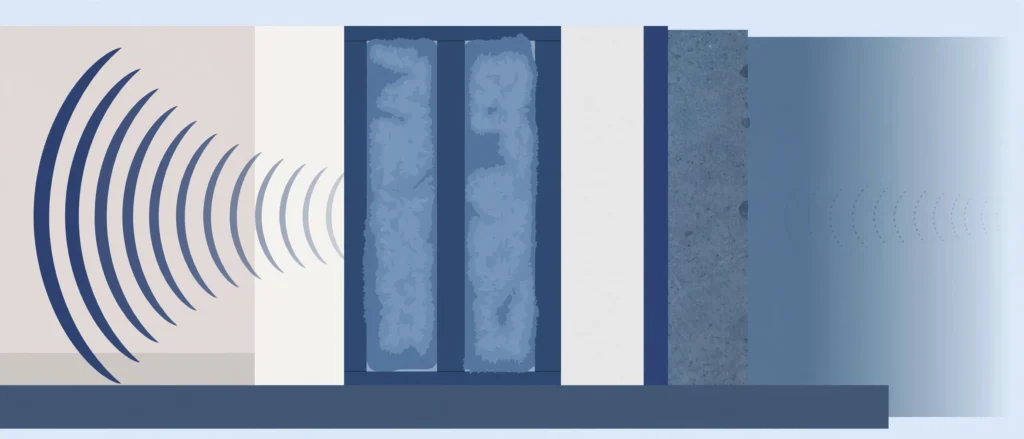
Sound Transmission Class, or STC, is the number printed on almost every soundproofing product and wall assembly you will ever consider for your basement. Higher is better, that much is obvious. What is not obvious is what the number actually measures, how big the difference between two numbers really is, and what the rating conveniently leaves out.
This guide translates STC into plain English: what it measures, the typical ranges for common basement assemblies, why a 5-point gain is a bigger deal than it sounds, and why STC alone will not tell you whether footsteps from upstairs will keep you awake.
What STC Actually Measures
STC is a single-number rating of how well a wall, floor, or ceiling assembly blocks airborne sound, things like voices, music, and TV audio. It is derived from laboratory tests where a wall is built between two rooms, sound is played on one side across a range of frequencies, and the difference in sound level is measured on each side.
The key word is “single-number.” The lab measures blocking at 16 different frequencies, from 125 Hz up to 4000 Hz. Those 16 measurements are then fitted to a standard reference curve, and the rating that fits becomes the STC number. That compression from 16 measurements to one number is both the usefulness of STC and its limitation: it hides where the assembly is strong and where it is weak.
Think of STC like a miles-per-gallon rating for a car. It tells you something real and comparable, and it is the right number to use when you are comparing options. But just as MPG does not tell you how a car handles in snow, STC does not tell you how a wall handles bass, impact noise, or the specific sound you actually care about.
Typical STC Ranges for Common Assemblies
The numbers below are typical ranges drawn from published laboratory test data and industry references. Real-world results vary with installation quality, flanking paths, and the specifics of each assembly, so treat these as guides for comparison, not guarantees for your basement.
Open joists, no drywall. An unfinished basement ceiling with exposed joists and no drywall typically lands around STC 28 to 33. Sound passes easily through the gaps, and the rating mostly reflects the subfloor above. If you can hear conversations clearly through the ceiling, this is probably what you have.
Single layer of 1/2-inch drywall on joists or studs. Adding one layer of standard drywall typically brings the assembly to around STC 33 to 38. This is the bare minimum finished ceiling or wall. Normal speech is muffled but still understandable, and loud TV or music comes through without much trouble.
Single layer of 5/8-inch drywall. The heavier Type X board adds a little mass and stiffness, typically landing around STC 35 to 40. The gain over 1/2-inch drywall is modest, a couple of points, because you have added mass without changing the structure of the assembly.
Double layer of drywall. Two layers of 5/8-inch drywall on the same framing typically reach around STC 40 to 45. Doubling the mass follows the mass law: roughly 5 more points. Loud speech becomes hard to understand, though it is still audible.
Double drywall with damping compound. Adding a viscoelastic damping compound (the well-known example is Green Glue) between two layers of drywall is where the gains get interesting. This assembly typically lands around STC 48 to 55, depending on the compound, the drywall, and the framing. The damping converts vibration into heat, which attacks the resonance dip that limits plain double drywall.
Staggered or double stud walls. Decoupling the two sides of the wall, so each side of drywall sits on its own set of studs, typically yields STC 50 to 60 or better when combined with insulation and double drywall. Decoupling is the single most powerful upgrade in wall construction because it breaks the rigid path that carries sound through the framing.
Poured concrete basement walls. A bare 8-inch poured concrete wall typically tests around STC 45 to 55. Concrete has enormous mass, which is why basement walls often block sound better than the floors and ceilings above them. The weak points in a basement are almost always the ceiling, the windows, and the doors, not the concrete.
Notice the pattern: the biggest jumps come from changing the structure of the assembly (adding mass, decoupling, damping), not from swapping one thin product for a slightly different thin product.
Why a 5-Point Gain Matters More Than It Sounds
STC is roughly logarithmic in how it relates to perceived loudness. A 5-point increase in STC does not mean sound is 5 percent quieter. It means the transmitted sound energy is substantially reduced, and the practical effect is that sounds which were clearly understandable become muffled and hard to follow.
Here is a rough way to think about it:
- A 3-point gain is barely noticeable. Most people would not reliably detect it.
- A 5-point gain is clearly noticeable. Speech that was intelligible becomes difficult to follow.
- A 10-point gain is dramatic. It is roughly perceived as cutting the loudness in half.
This is why the mass law matters so much in soundproofing: doubling the mass of a wall buys you about 5 STC points, and 5 points is the threshold where the improvement becomes obvious in daily life. When a product promises a 2- or 3-point gain for a lot of money, that is a signal to look for a structural upgrade instead.
What STC Does Not Tell You
STC has three well-known blind spots, and all three matter in basements.
Low-frequency sound. The STC test starts at 125 Hz. Bass from a home theater subwoofer, a kick drum, or an HVAC rumble lives at or below that floor, so the rating simply does not capture it. Two assemblies can share the same STC rating while performing very differently on bass. If low-frequency noise is your problem, look for test data that reports transmission loss at specific low frequencies, and plan on mass, decoupling, and lots of it.
Impact noise. STC measures airborne sound. Footsteps, dropped objects, and anything that strikes the structure travel as vibration through the framing, and STC says nothing about them. That is what the Impact Insulation Class (IIC) rating is for. IIC is measured by dropping a standardized tapping machine on a floor and measuring the sound in the room below. A basement ceiling can have a respectable STC rating and a terrible IIC rating at the same time, which is exactly what happens with a plain drywall ceiling under a hard-surface floor.
Flanking paths. Lab STC numbers are measured in ideal conditions with the test wall sealed perfectly into the test chamber. Your basement has ducts, pipes, recessed lights, a stairwell opening, and shared framing that carry sound around the wall or ceiling. In the real world, flanking often limits what you actually hear more than the STC of the assembly itself. Sealing gaps with acoustic caulk, wrapping ducts, and addressing the obvious holes frequently buys more quiet than upgrading an already-decent assembly.
Putting It Together: Reading STC Like a Pro
When you are comparing options for your basement, use STC the way it was meant to be used: as a comparative tool between assemblies tested the same way, not as a promise of what you will hear.
A few rules of thumb:
- Compare assemblies, not products. A product that “adds 5 STC” is only meaningful in the context of the assembly it was tested in.
- Distrust round numbers that sound too good. If a thin, light product claims a 15-point gain on its own, check what assembly that was measured in.
- Pair STC with IIC when floors are involved. For a basement ceiling under a living space, you need both numbers to know what you are getting.
- Budget for the weak links. A high-STC wall with a hollow-core door and an unsealed duct is a low-STC room. Doors, windows, and penetrations usually deserve attention before the wall itself gets a third layer.
- Remember that installation is part of the rating. Lab assemblies are built perfectly. Seams, gaps, and shortcuts in the field routinely cost 3 to 5 points, which is exactly the margin between “noticeable improvement” and “waste of money.”
For a typical basement finishing project, the practical sweet spot is a ceiling or wall assembly in the STC 48 to 55 range: double drywall with damping, sealed airtight, with the ducts and penetrations addressed. Beyond that, you are usually chasing flanking paths rather than buying mass, and the money goes further on doors, seals, and duct treatment.
For a step-by-step application of these principles, see our guide to soundproofing a basement ceiling.
FAQ
What is a good STC rating for a basement ceiling?
For a basement ceiling under living space, an assembly in the STC 48 to 55 range, typically double drywall with damping compound, sealed airtight, is a solid target. Below STC 40, normal speech and TV audio will still be clearly audible from below.
What is the difference between STC and IIC?
STC measures how well an assembly blocks airborne sound like voices and music. IIC measures how well a floor assembly resists impact sound like footsteps. A basement ceiling needs both: STC for the TV upstairs, IIC for the footsteps.
Can I add STC points without tearing down drywall?
Yes. Adding a second layer of drywall with damping compound over the existing layer, sealing all gaps with acoustic caulk, and upgrading doors and outlet seals can typically add 5 to 10 points without demolition. Mass loaded vinyl between the layers is another option.
Why can I still hear bass if my wall has a high STC?
STC testing starts at 125 Hz, so deep bass falls partly or entirely outside what the rating measures. Two walls with the same STC can perform very differently on low frequencies. Bass needs mass, decoupling, and damping working together.
Does insulation increase STC?
Insulation in the cavity typically adds 3 to 5 STC points by damping resonances in the air space between the wall faces. It is a worthwhile, inexpensive upgrade, but it is not a substitute for mass and decoupling.
What STC do I need so upstairs cannot hear my home theater?
There is no magic number, because bass and impact fall outside STC. As a practical target, aim for an assembly around STC 55 or better with decoupled framing or resilient channel, damping compound, and sealed construction, and treat the doors and ducts as part of the system.
Is a higher STC always better?
Up to a point. Above roughly STC 55 to 60, flanking paths, doors, ducts, and shared structure usually dominate what you hear, so money spent pushing the wall assembly higher often buys less quiet than money spent on the weak links.